I usually play word games because I want a quiet break, not because I’m looking for a new administrative responsibility. Wordle fits neatly beside a cup of coffee. You solve one word, feel clever for a moment, and continue with your day.
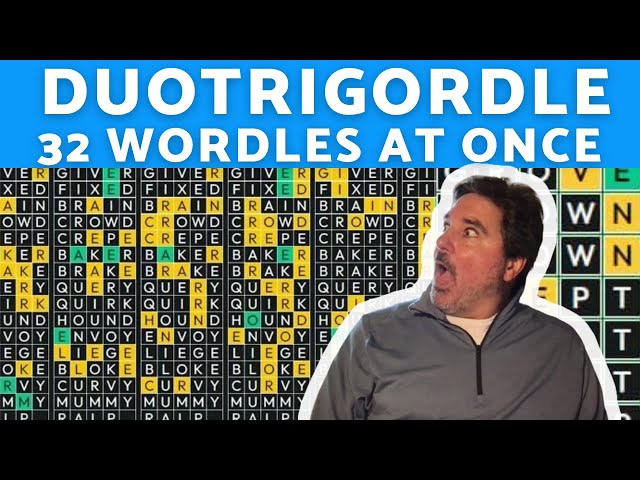
Duotrigordle hands you 32 words.
Yes, thirty-two. The game takes the familiar colored-letter format and stretches it across a huge collection of boards, all controlled by the same guesses. You have 37 attempts to solve every five-letter word in a standard game. That means you only get five guesses beyond the 32 answers themselves, which sounds almost impossible until you understand how much work each guess can do.
I expected Duotrigordle to feel like a novelty designed for people who thought Wordle was too peaceful. Instead, I found a thoughtful online word game that rewards planning, patience, and the ability to ignore a mildly terrifying amount of information.
It’s not exactly relaxing, but it is compelling.
What Makes Duotrigordle Different?
In an ordinary Wordle puzzle, each guess affects one answer. In Duotrigordle, every word you enter appears on all 32 boards at once. A single opening guess may reveal useful letters in twenty different places, while a later answer can unexpectedly solve or simplify several other puzzles.
The color rules remain familiar. Green means the letter is correct and in the right position. Yellow means the answer contains the letter, but it belongs somewhere else. Gray usually indicates that the letter isn’t part of that particular word.
The official Duotrigordle game includes the standard daily puzzle alongside Sequence, Jumble, Perfect Challenge, historic games, statistics, and practice options. That’s a generous selection for a browser-based word puzzle, especially because each mode changes the way you think rather than merely changing the screen color.
You don’t need an account to understand the basic appeal. Open the game, enter a valid five-letter word, and watch 32 sets of clues appear. The difficult part is deciding what deserves your attention next.
My Advice: Don’t Try to Remember Everything
New Duotrigordle players often believe they need to track all 32 words mentally. You don’t. In fact, trying to remember every yellow letter and possible answer is a reliable way to become tired and annoyed.
Use the interface. Scroll through the boards, look for strong patterns, and let the colored tiles hold the information for you. The game offers input hints that can display known green letters and warn you about guesses that conflict with confirmed clues. I’d leave those features switched on while learning.
Some puzzle fans dislike assistance on principle. I understand that, but Duotrigordle already asks you to manage 32 simultaneous answers. Using a reminder that prevents you from accidentally ignoring a green letter isn’t the same as asking the game to reveal the word.
Begin with words containing common, non-repeating letters. Your opening guesses should cover a useful mix of vowels and consonants rather than chase an immediate solution on one lucky board. A word such as STARE tests five popular letters. A second word can explore a different group rather than repeating most of the same characters.
I won’t pretend there’s one perfect opening combination. Different players favor different words, and Jumble Mode deliberately removes that comfort by choosing the first three guesses for you. The important thing is coverage. Early guesses should provide information across the entire puzzle.
The Moment the Game Starts Feeling Manageable
After two or three broad guesses, Duotrigordle begins to change. The screen that initially looked like colored static starts producing recognizable patterns. You’ll see endings such as “-OUND,” “-ATCH,” or “-IGHT.” A few words may be almost completely green.
This is the point where I stop scanning every board equally and begin looking for answers I can solve with confidence. Each correct answer reduces the workload, and the word you enter continues testing letters across all unfinished boards.
For example, imagine that one board strongly suggests PLANT while another could be MIGHT, NIGHT, RIGHT, or SIGHT. Solving PLANT first may test letters that help distinguish the second group. Guessing NIGHT immediately would be risky unless the available clues already rule out the alternatives.
That’s the part of Duotrigordle I enjoy most. The game isn’t only asking, “What is this word?” It’s asking, “Which word should you solve now?”
You’re constantly balancing certainty against information. An obvious answer clears a board safely. A carefully chosen answer may also reveal the missing detail on several others. Good Duotrigordle strategy comes from doing both whenever possible.
Common Mistakes New Players Make
The first mistake is spending too many opening guesses on letter coverage. Testing the alphabet feels productive, but you can’t afford to keep gathering general information forever. Remember, you have 37 attempts for 32 solutions. After a sensible opening, start entering actual answers.
The second mistake is guessing uncertain words too early. Patterns with several possibilities can consume your limited margin quickly. If a board might contain BATCH, CATCH, HATCH, LATCH, MATCH, PATCH, or WATCH, don’t run through them one by one. Solve other boards and allow their answers to test the missing first letter.
Repeated letters create another problem. Players often assume that seeing one yellow letter means the solution contains exactly one copy. It might contain two. When an apparently obvious pattern refuses to work, ask whether a letter appears more than once.
Finally, don’t ignore solved-looking boards for too long. I’ve seen puzzle players gather beautiful information across the grid, only to reach the final guesses with too many confirmed answers left to type. Knowing the answers isn’t enough. Each one still needs its own entry.
What Experienced Players Can Chase
Once completing the standard Daily Duotrigordle becomes routine, efficiency becomes the real challenge. You can try finishing with fewer guesses, improving your time, or maintaining a streak. The available statistics and speedrun timer make those goals easier to track.
Sequence Mode is a clever test for regular players because it reveals only one board at a time. You receive 39 guesses, but you can’t skip an uncertain puzzle and solve something easier elsewhere. It rewards strong pattern recognition and careful elimination.
Jumble Mode chooses the first three words automatically and gives you 38 attempts. I find it refreshing because it exposes how dependent we become on familiar starting words. When those comfortable openings disappear, you have to adapt to whatever information the game provides.
Perfect Challenge is the serious one. You must complete 32 boards in exactly 32 guesses, with your first entry automatically accepted as correct. There’s no space for a wasted move. I’d recommend it only after you’re comfortable reading the larger grid and recognizing common five-letter patterns quickly.
Historic puzzles and Practice Mode are useful when one daily game isn’t enough. Practice is also the best place to test a new opening strategy. It’s much easier to experiment when a failure doesn’t break a streak you’ve been quietly bragging about.
Design, Accessibility, and Everyday Use
Duotrigordle presents an enormous amount of information, so its display settings matter. You can hide completed boards, collapse empty rows, change how many boards appear in each column, and disable animations if performance becomes an issue. Colorblind Mode provides stronger contrast for players who have difficulty distinguishing the standard clue colors.
The site can also be installed on a phone’s home screen as a web app and supports offline play. That’s convenient, although I still prefer Duotrigordle on a larger display. Thirty-two boards ask a lot from a small phone screen, and frequent scrolling can make the later stages harder to organize.
Solve Assist is an interesting option. It can automatically finish boards whose answers are fully deducible, saving you from some mechanical typing. Casual players may appreciate the smoother pace, while competitive solvers will probably keep it disabled so every answer remains their responsibility.
The Downsides
Duotrigordle demands more time than most daily word games. A successful puzzle can feel like a genuine achievement, but a failed attempt may feel as if twenty minutes disappeared into one obscure answer.
The ending can become repetitive too. Once you’ve logically solved several boards, entering each answer separately isn’t always exciting. It’s more like completing paperwork after the investigation is over.
The large interface also creates occasional confusion. You may forget which board you were studying or scroll past a nearly complete word. Display options help, but Duotrigordle will never be as tidy as a single-grid puzzle. Its excess is the entire idea.
Duotrigordle Review Verdict
Duotrigordle is worth playing if ordinary Wordle no longer gives you enough to think about. It keeps the accessible five-letter format but adds planning, prioritization, and a much stronger sense of momentum. Solving one board can unlock another, then another, until the impossible-looking grid suddenly feels under control.
Beginners should focus on broad opening coverage, use the input hints, and solve confident answers before gambling on ambiguous patterns. Experienced players can explore Sequence and Jumble modes, refine their guess efficiency, revisit historic puzzles, or attempt the intimidating Perfect Challenge.
I still wouldn’t call Duotrigordle a quick coffee-break game. Sometimes the coffee is cold by the time I’m finished. Yet that longer commitment makes victory feel meaningful in a way that many daily puzzles don’t.
Basically, Duotrigordle turns one small word mystery into a full morning project. Strangely enough, I mean that as a compliment.